For months the scale dropped every week. Then nothing: three, four weigh-ins at the same number. Before deciding “it stopped working”, look at what the clinical trials of Wegovy® and Mounjaro® (sold as Zepbound® for weight management in the US) actually show: weight loss on a GLP-1 is a curve that slows down and then flattens, not a straight line. The plateau is part of the treatment. Here is what the data say, how to tell a real plateau from scale noise, and the 5% marker doctors around the world use to judge whether the drug is doing its job.
⚕️ This article summarises official EU and US product information, published trials and clinical guidelines, for information only. It replaces neither your medication leaflet nor advice from your doctor or pharmacist.
What the trial curves show
In every large published trial, weight loss follows the same shape: fast at first, slower afterwards, then flat.
- STEP 1 (semaglutide 2.4 mg, Wegovy®): after 68 weeks, treated participants had lost 14.9% of their body weight on average, versus 2.4% on placebo. Everyone in both groups also received lifestyle support on diet and physical activity.
- STEP 5, the same drug over two years: 15.6% lost at week 52, 15.2% at week 104. The authors write that weight loss “plateaued after approximately week 60 and was maintained for the remainder of the study”. In other words, the second year does not make you lose more; it keeps you there.
- SURMOUNT-1 (tirzepatide, Mounjaro® / Zepbound®): after 72 weeks, 15.0%, 19.5% and 20.9% lost depending on the dose (5, 10 or 15 mg), versus 3.1% on placebo.
- SURMOUNT-1 at three years, in participants who had prediabetes at baseline: 12.3%, 18.7% and 19.7% lost at week 176, versus 1.3% on placebo. Three years on, the weight is still off, but it is no longer falling.
In one sentence: the drug does not make you lose weight forever; it shifts your body’s balance point and then holds it there. The plateau is the treatment’s second phase.
Why weight loss slows, then stops
The trials describe the shape of the curve, not every mechanism behind it. But two simple facts explain a large part of it.
A lighter body burns less. Every pound or kilo lost slightly lowers the energy needed to live and move. With the same intake, the gap that melted weight away at the start gradually closes, until intake and expenditure balance again. That new balance is what we call a plateau.
The effect on appetite is stable, not growing. Once the maintenance dose is reached, drug levels even out from one week to the next (see our article on the half-life of Wegovy and Mounjaro). Nothing suggests the effect on appetite grows after that. The body, meanwhile, adapts to a lower weight.
Plateau or just scale noise?
Before calling it a plateau, make sure your weight really has stopped moving. From one day to the next, water, salt, digestion, the menstrual cycle or a long day sitting down move the number without any change in body fat. Three practical rules:
- Weigh yourself once a week, same day, in the morning, same conditions.
- Read the trend, not the last weigh-in. A rolling 7-day average removes most of the water noise.
- Count in weeks, not days. A plateau is three or four flat weekly weigh-ins, not one weekend.
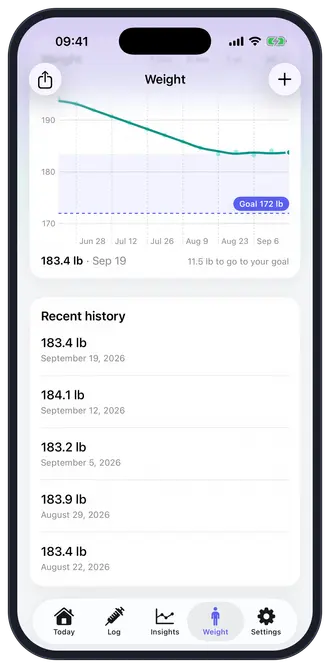
That is exactly what the Weight tab in Doza does, in pounds or kilograms: a 7-day smoothed trend, your goal line and the distance left, so you read the shape of the curve rather than today’s number.
The 5% marker: how doctors judge whether the drug is working
Wherever you live, the same number comes up: 5% of your starting weight. The trials report the share of participants who reach it, and clinical guidelines use it as the line between “responding” and “not responding”.
The Endocrine Society’s guideline on the pharmacological management of obesity puts it plainly (recommendation 1.5): if a patient’s response is “deemed effective (weight loss ≥ 5% of body weight at 3 mo) and safe, we recommend that the medication be continued. If deemed ineffective (weight loss < 5% at 3 mo) or if there are safety or tolerability issues at any time, we recommend that the medication be discontinued and alternative medications or referral for alternative treatment approaches be considered.”
Health systems then build their own review points around that marker. In England, NICE says to consider stopping semaglutide “if less than 5% of the initial weight has been lost after 6 months of treatment”, and, for tirzepatide, to decide whether to continue “if less than 5% of the initial weight has been lost after 6 months on the highest tolerated dose”; NHS semaglutide is also limited to specialist weight-management services and two years (details in our article on Mounjaro and Wegovy on the NHS). In France, the health authority recommends a review at around six months against the same 5% line (see our guide to French coverage). Your prescriber may use three months, six months or a service protocol; the marker is the same.
In practice, there are two very different situations:
- You have already lost 5% or more, and your weight is levelling off. You are in the scenario seen in the trials: the response marker is passed, the plateau is expected. The conversation with your doctor shifts to maintenance.
- You are stuck below 5% after three months or more. This is the one not to let drift. It is not necessarily a failure either: a maintenance dose reached only recently, skipped doses, eating that has drifted (see why you are not losing weight on a GLP-1). But the conversation with your doctor should happen before the review, not after.
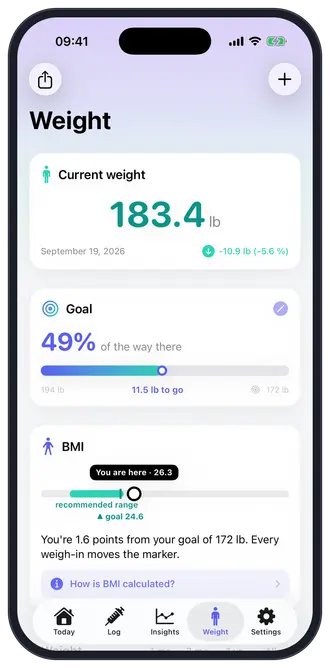
Doza shows your loss as a percentage of your starting weight on the Weight tab, so the 5% question is answered at a glance. In the screenshots in this article, the example profile is at −5.6%: the marker is passed; this is the first scenario above.
📱 Your doses, your weight, your percentage: in one place. Doza keeps your log of injections and weigh-ins, draws the trend and the goal line, and shows your loss against your starting weight. Your measurements and your doses never leave your iPhone. Discover Doza →
What the product information says when weight stops moving
Neither the EU nor the US product information gives a rule for what to do about a plateau (the EU Wegovy® Summary of Product Characteristics, or SmPC, uses the word only to describe the STEP 5 curves, with a plateau after week 68 on semaglutide), but both frame dose escalation and its limits, and they agree on the essentials.
- Wegovy®: the EU SmPC and the US prescribing information set the same schedule: 0.25 mg, stepping up every 4 weeks (0.5, 1, 1.7 mg) to the usual 2.4 mg maintenance dose, a 16-week climb. Both now list a 7.2 mg strength as well; the EU SmPC allows it if needed under certain conditions, and specifies that if there is no further clinical improvement in body weight at 7.2 mg, the dose is brought back to 2.4 mg.
- Mounjaro® / Zepbound®: the starting dose is 2.5 mg for 4 weeks; the EU SmPC gives recommended maintenance doses of 5, 10 and 15 mg, in 2.5 mg steps after at least 4 weeks on the current dose; both the EU SmPC and the US Zepbound® label set 15 mg as the maximum.
What this means for you: if your weight is stalling before you have reached your maintenance dose, or shortly after reaching it, it may simply be too early to call it a plateau. The decision to adjust belongs to your doctor, who also takes digestive tolerance into account. A precise log of your doses and weigh-ins is the best support for that discussion.
When to talk to your doctor
- Your weight has been flat for more than a month before reaching 5% loss.
- The plateau comes with steady regain over several weeks.
- You have skipped or shifted several doses and are unsure how to resume (the EU rules are in our article on missed doses; the US Wegovy® label uses a different window, see why you are not losing weight).
- You tolerate the current dose poorly: the EU Wegovy® SmPC allows delaying an increase or going back to the previous step, and the US label suggests delaying escalation for 4 weeks, but that is your doctor’s call.
FAQ — plateaus on Wegovy and Mounjaro
How long until the plateau?
In STEP 5, with semaglutide 2.4 mg, weight loss plateaued after approximately week 60 and was maintained through week 104. The SURMOUNT trials show the same curve shape with tirzepatide. The exact timing varies from person to person.
Does a plateau mean the drug has stopped working?
No. In the trials, the weight lost is largely maintained as long as treatment continues: 15.2% loss at two years in STEP 5, and up to 19.7% at three years in SURMOUNT-1 among participants with prediabetes. The plateau is the maintenance phase.
How do I know it is a real plateau?
Weigh yourself once a week under the same conditions and look at the trend over several weeks. Three or four flat weekly weigh-ins point to a plateau; a single weigh-in means nothing.
Is there an official rule for stopping if I have not lost 5%?
Not for adults in the EU or US product information for Wegovy®, Mounjaro® or Zepbound® (the EU Wegovy® SmPC has one for adolescents only: stop and re-evaluate if BMI has not fallen by at least 5% after 12 weeks at the maintenance or maximum tolerated dose), but guidelines do set one. The Endocrine Society recommends continuing a weight-loss medication when loss reaches 5% of body weight at 3 months and discontinuing it, or considering alternatives, when it does not. In England, NICE says to consider stopping semaglutide, or to decide whether to continue tirzepatide, if less than 5% of the initial weight has been lost after 6 months. France recommends a review at around six months. Your doctor follows the rule in force where you are treated.
Should the dose go up when I stall?
That is your doctor’s decision, never yours alone. The product information frames dose escalation (16 weeks for Wegovy®, 2.5 mg steps for Mounjaro® and Zepbound®) and takes digestive tolerance into account.
Sources: STEP 1, N Engl J Med 2021 · STEP 5, Nat Med 2022 (plateau around week 60, results at 104 weeks) · SURMOUNT-1, N Engl J Med 2022 · SURMOUNT-1 at 176 weeks, N Engl J Med 2025 · Wegovy SmPC and Mounjaro SmPC (EMA, accessed 19 September 2026) · Wegovy US prescribing information (revised June 2026) and Zepbound US prescribing information · Endocrine Society, Pharmacological Management of Obesity, J Clin Endocrinol Metab 2015 (recommendation 1.5) · NICE TA875 (semaglutide, recommendations 1.1 and 1.2) and NICE TA1026 (tirzepatide, recommendations 1.1 and 1.2). Last updated: 19 September 2026. Published by Doza, a GLP-1 tracking app made in France. This article is general information, not medical advice: dose and treatment decisions belong to your doctor.