You started Wegovy® or Mounjaro® (sold as Zepbound® for weight management in the US) a few weeks ago, and the scale is not moving. Or barely. Before concluding that the treatment “does not work on you”, there are six explanations far more common than a true lack of response, and almost all of them can be checked with a simple log. Here they are, in the order you should look at them, with what the official product information and the trials say.
⚕️ This article summarises official EU and US product information, published trials and clinical guidelines, for information only. It replaces neither your medication leaflet nor advice from your doctor or pharmacist.
It is too early: you are still in dose escalation
The numbers everyone quotes (“15%”, “20%”) are results at 68 weeks for Wegovy® (STEP 1) and 72 weeks for Mounjaro® and Zepbound® (SURMOUNT-1), at the maintenance dose. The first weeks are not spent at that dose.
- Wegovy®: the EU Summary of Product Characteristics (SmPC) and the US prescribing information set the same climb: 0.25 mg, then 0.5, 1 and 1.7 mg, 4 weeks each, before the 2.4 mg maintenance dose, 16 weeks in all. The purpose of the early steps is to reduce digestive side effects, not to maximise weight loss.
- Mounjaro® / Zepbound®: the starting dose is 2.5 mg for 4 weeks; the recommended maintenance doses are 5, 10 and 15 mg. At 2.5 mg you are not yet on a maintenance dose.
If you are in month two, your body has not yet seen the dose that produced the trial results. That delay is part of the schedule set by the label.
Skipped or shifted doses
These drugs are injected once a week because they leave the body slowly: the half-life is about one week for semaglutide and about 5 days for tirzepatide (details in our article on the half-life of Wegovy and Mounjaro). A skipped dose means a level that drops for several days before climbing back. Two skipped doses in a row, and most of a month’s effect is gone.
The official rules are precise, but they are not the same everywhere:
- Wegovy®, EU SmPC: take a missed dose within 5 days; beyond that, skip it and resume on the scheduled day. If more doses are missed, a lower re-initiation dose should be considered.
- Wegovy® injection, US label: take the missed dose as soon as possible if the next scheduled dose is more than 2 days away; if it is less than 2 days away, skip it. If two or more consecutive doses are missed, escalation is restarted at a lower dose.
- Mounjaro® (EU) and Zepbound® (US): take a missed dose within 4 days (96 hours); beyond that, skip it.
In every case: never a double dose, and follow the leaflet of the product you were given. Our article on missed doses walks through the EU rules day by day.
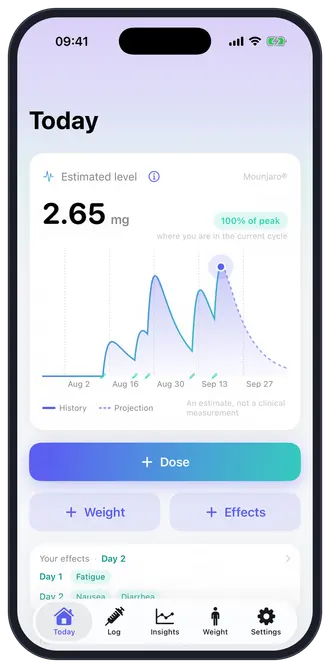
This is the easiest case to check in a log. On Doza’s estimated level curve, a skipped week is visible immediately: the dip, then the climb back. If your weight is flat and your curve shows deeper, longer dips than usual, you have probably found your cause.
Less hunger is not the same as eating well: what the indication says
This is the point the product information puts first, in the EU and the US alike. The EU SmPCs indicate Wegovy® and Mounjaro® “as an adjunct to a reduced-calorie diet and increased physical activity”; the US labels indicate Wegovy® and Zepbound® “in combination with a reduced calorie diet and increased physical activity”. That wording is the indication itself: the drug is licensed as an add-on to those changes, not a substitute for them. In STEP 1, every participant, including those on placebo, received lifestyle support on diet and activity; the placebo group lost 2.4% with that support alone.
The drug reduces hunger; it does not choose what is on the plate. Two situations come up often:
- Eating too little, then compensating. Skipping meals because “I’m not hungry” can lead to evening snacking and fatigue, and may contribute to muscle loss over time. The body needs regular meals, even small ones: the label indicates the drug alongside a reduced-calorie diet, not a fast.
- Calories that do not fill you up. Sugary drinks, alcohol, juices, coffee-shop drinks, sauces: they slip past satiety and add up unseen, even as portions shrink. Eating less does not mean eating better.
The safest route: rebalance your diet with a professional, a registered dietitian or a doctor specialising in nutrition, rather than alone with a calorie app. Many health systems build that support in: in England, NICE recommends these drugs within weight-management services or alongside diet and activity support; in France, a documented nutritional programme is a prerequisite for coverage, and lifestyle measures are expected to continue on treatment. Doza does not count calories, and that is deliberate: the log records your doses, your weight and your effects; what goes on the plate is worked out with someone who knows you.
The scale lies in the short term
From one weigh-in to the next, a short night’s sleep, a salty meal, digestion or the menstrual cycle are enough to shift the number without any change in body fat. Weighing yourself every morning and declaring failure on Tuesday because Monday was lower is the surest way to get discouraged for nothing.
- Weigh yourself once a week, same day, same time, same conditions.
- Judge on a trend over several weeks, not one weigh-in.
- Set a realistic goal: in the trials, the average is 15 to 21% of starting weight after more than a year, not in three months.
Doza’s Weight tab shows a 7-day smoothed trend, your goal and the distance left, in pounds or kilograms, precisely so that today’s weigh-in does not dictate your mood.
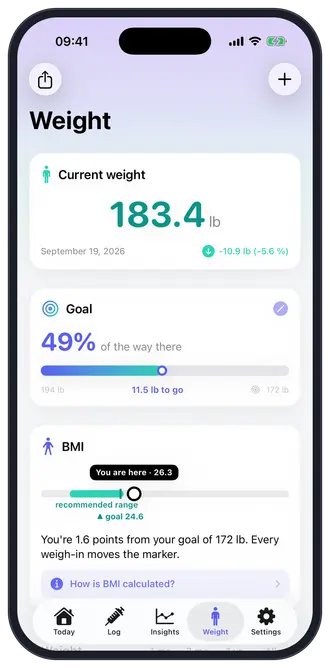
📱 Your doses, your weight, your effects: a log, not a counter. Doza shows your estimated level curve, your weight trend and the gap to your goal, so you arrive at your appointment with facts. Your measurements and your doses never leave your iPhone. Discover Doza →
Non-responders exist, and the trials count them
It has to be said plainly: a minority of trial participants lost less than 5% despite the lifestyle support. In STEP 1, 86.4% of participants on semaglutide lost at least 5% of their body weight; in other words, about one in seven had not reached that threshold at 68 weeks. In SURMOUNT-1, the share below 5% ranges from 9% to 15% depending on the tirzepatide dose.
That is why doctors use a checkpoint. The Endocrine Society guideline recommends continuing a weight-loss medication when loss reaches 5% of body weight at 3 months, and discontinuing it or considering alternatives when it does not. Health systems set their own timing: in England, NICE says to consider stopping semaglutide, or to decide whether to continue tirzepatide, if less than 5% of the initial weight has been lost after 6 months (on the highest tolerated dose for tirzepatide); in France, the health authority recommends a review at around six months. It is a medical decision, neither a failing on your part nor an automatic stop, to be made with your numbers in front of you. If you stall after passing the 5% marker, see our article on the plateau.
Another cause to explore with your doctor
If the first five points are ruled out, medical causes remain that only your doctor can investigate: medicines that promote weight gain (certain antidepressants, antipsychotics or corticosteroids), an underactive thyroid, poor sleep or untreated sleep apnoea, menopause, polycystic ovary syndrome. None of these can be self-diagnosed: bring your log, your weigh-ins and the list of your medicines.
What not to do
- Raise the dose yourself or shorten the interval. The steps are prescribed; going up is decided with the doctor, taking tolerance into account.
- Double a dose after a missed one. Never.
- Stop quietly because “it is not working”. Talk about it: a dose adjustment, nutritional support or a check-up can change the picture.
FAQ — no weight loss on a GLP-1
How long before I should see an effect?
Trial results are measured after more than a year of treatment, dose escalation included; the maintenance dose is only reached after 16 weeks for Wegovy® and at least 4 weeks for Mounjaro® and Zepbound®. Many people do start losing during escalation; a slow start is nothing unusual.
Can the drug simply not work on me?
Yes, it is possible but uncommon: in STEP 1, 13.6% of participants on semaglutide lost less than 5% of their weight; in SURMOUNT-1, 9 to 15% depending on the dose. This is what the 3-to-6-month review with your doctor is for.
Should I eat even when I am not hungry?
Yes: the drug is indicated alongside a reduced-calorie diet, not a fast. Skipping meals can lead to snacking and fatigue, and may contribute to muscle loss. A registered dietitian or a doctor specialising in nutrition can plan suitable meals.
Can one missed injection explain a week without loss?
Yes. The half-life is long (about one week for semaglutide, 5 days for tirzepatide): a skipped dose lets the level fall for several days. Take it within the window in your leaflet (Wegovy® injection: within 5 days in the EU; in the US, as soon as possible unless the next dose is under 2 days away. Mounjaro® and Zepbound®: within 4 days), never as a double dose.
Will Doza tell me why I am not losing weight?
No, and it does not claim to. Doza keeps the log of your doses, weight and effects, and shows your estimated level and your trend. Drawing conclusions is up to you and your doctor.
Sources: Wegovy SmPC and Mounjaro SmPC (EMA, accessed 19 September 2026) · Wegovy US prescribing information (revised June 2026) and Zepbound US prescribing information · STEP 1, N Engl J Med 2021 · SURMOUNT-1, N Engl J Med 2022 · Endocrine Society, Pharmacological Management of Obesity, J Clin Endocrinol Metab 2015 (recommendation 1.5) · NICE TA875 (semaglutide) and NICE TA1026 (tirzepatide), recommendations 1.1 and 1.2. Last updated: 19 September 2026. Published by Doza, a GLP-1 tracking app made in France. This article is general information, not medical advice: dose and treatment decisions belong to your doctor.